At first glance, the legal situation surrounding hemp products seems contradictory. Cannabis in Switzerland is neither universally legal nor as straightforward as many headlines suggest.
That's precisely why a sober look at possession, consumption, medicine, cultivation, and politics is worthwhile. Here you'll find the most important information on a topic that has been oscillating between prohibition, reform, and reality in Switzerland for years.
The topic of cannabis in Switzerland does not begin with legalization
Many debates start with the false assumption that smoking cannabis is either already fully legal or still uniformly strictly prohibited in all cases. In reality, the situation lies in between. The question: Is cannabis legal in Switzerland? only yields a useful answer if one first distinguishes between prohibition, toleration, decriminalization, and permitted medical use.
The short answer is therefore: No, cannabis is not generally legalized in Switzerland. To the second question, whether cannabis is decriminalized in Switzerland, the answer is: only partially. Possession of small quantities is treated differently than smoking weed, trading, or cultivating. This is precisely where the topic begins, not with the legalization of cannabis in Switzerland.
A look at history also helps to put things into perspective. For years, politicians have been grappling with the question of whether new regulation would be more sensible than the black market. Nevertheless, there is still no general cannabis legalization in Switzerland today, but rather a mixture of prohibition, exceptions, and pilot models.
In Switzerland, the Narcotics Act regulates cannabis more strictly than many think
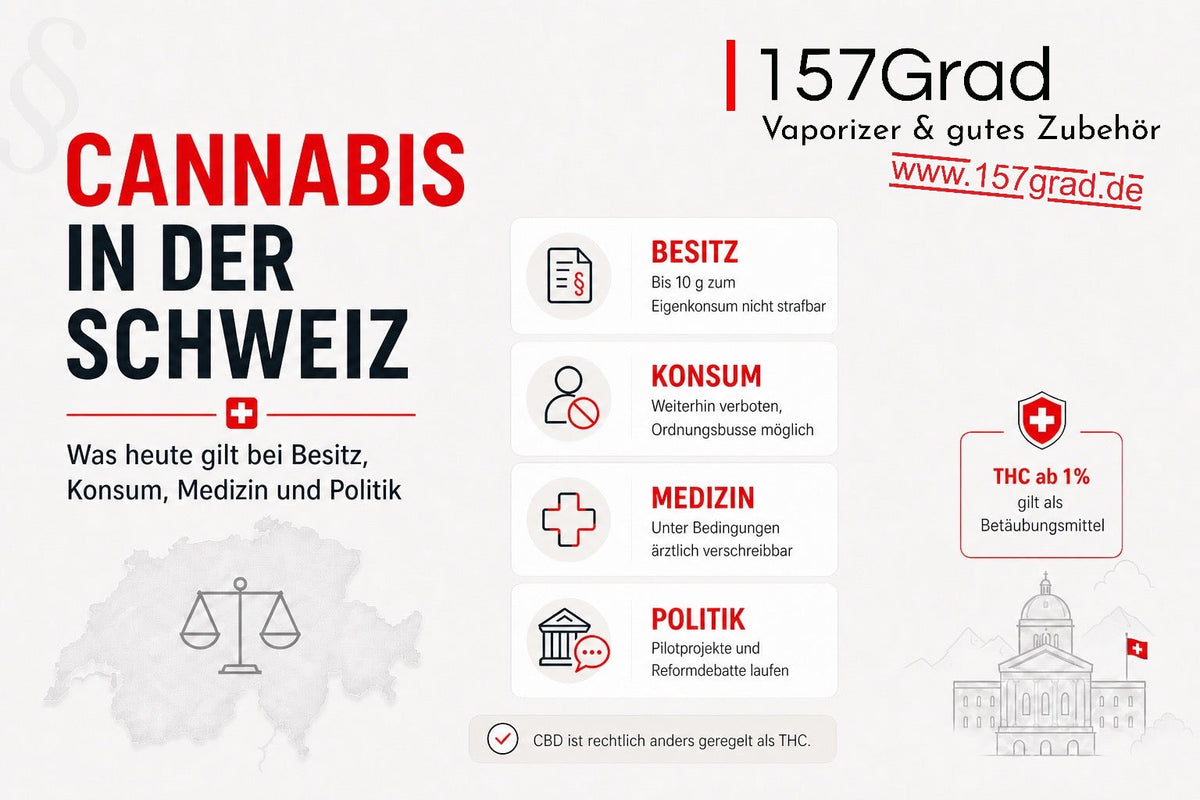
The legal basis lies primarily in the Narcotics Act. According to this regulation, cannabis, also known as broccoli, with a THC content of 1 percent or more, is considered a narcotic. This means that consumption, trade, production, import, and cultivation are generally prohibited, even if the practice varies depending on the case and quantity.
Important everyday differences
|
Area |
Current Situation |
Practical Consequence |
|---|---|---|
|
Consumption by adults |
Prohibited |
Fine possible |
|
Possession up to 10 grams for personal use |
Not punishable |
No carte blanche for consumption or distribution |
|
Cultivation and trade |
Generally prohibited |
Proceedings and sanctions possible |
|
Medical use |
Permitted under certain conditions |
Medical prescription possible |
This overview shows why cannabis consumption, possession, and other drugs should not automatically be treated equally. In road traffic, the Road Traffic Act and the Road Traffic Regulations also apply. THC in the blood is particularly strictly accounted for there, which is why the practice in this area is very close to zero tolerance. In this context, it should be mentioned that there are also practical THC tests.
For you, it is therefore important not only whether something is permitted or prohibited, but also in what context it occurs. Anyone who only looks at a single keyword quickly overlooks how narrow the legal framework still is in everyday life.
For cannabis in Switzerland, the quantity often determines the consequences
In everyday life, the quantity often determines whether an incident is treated as a minor offense or a serious violation. Possession of up to 10 grams for personal use is not punishable for adults. However, this does not mean that consumption is automatically permitted.
If a person is caught consuming, whether smoking or vaping, the police can impose a fine. If, however, it concerns more than personal use, distribution, or other aggravating circumstances, the risk of formal proceedings increases. For a person driving under the influence, traffic law can also play a major role.
The line is therefore not only drawn at a number, but always also in the context. Possession remains different from sale. A small incident can quickly become a more serious case if market, trade, or repeated behavior are added. In extreme cases, imprisonment can even be considered.
Buying cannabis in Switzerland sounds simple, but is legally tricky
Many people wonder if they can buy cannabis in Switzerland. The honest answer is: not legally in the normal recreational area at present. When people talk about buying cannabis in Switzerland, they often mean either the illegal market, low-THC products, or controlled distribution in pilot trials.
How to recognize the current purchasing situation
-
A normal recreational purchase of THC-containing cannabis is not generally permitted today, which also applies to cannabis cookies.
-
Distribution in pilot projects only concerns approved adults under clear guidelines.
-
These models do not replace free trade.
-
CBD products follow different rules than classic THC-containing cannabis.
-
Specialized shops are currently more of a political draft than an everyday reality.
It is precisely here that the debate often becomes unclear. A planned sale in a later regulated market is different from the current situation. This is also why the question of cannabis consumption in Switzerland is often mixed with the question of purchase and possession, although legally several levels must be distinguished.
If you want to properly classify the purchase, you must therefore separate the present from a possible future. The current market is not an open recreational market, but is legally highly restricted and in many areas still prohibited, although the acquisition of vaporizers for hemp flowers has not been prohibited.
When it comes to cannabis in Switzerland, you have to clearly separate CBD from THC
Not every hemp product falls under the same rules. CBD and other low-THC cannabis products are to be classified differently than classic cannabis with higher THC content. It is precisely at this point that many misunderstandings arise in everyday life.
Cannabis as a substance is not a uniform block. The active ingredient content, product type, and intended use are crucial. Anyone who equates CBD flowers, concentrates, or other cannabis products such as canna-butter with recreational cannabis quickly draws false conclusions about possession, purchase, and consumption.
For you, this means: Always check exactly what is being talked about. Even for a single person, the same plant can be treated very differently legally, depending on whether it concerns THC, CBD, medicine, or controlled distribution. This is also where the most important risks for misunderstandings and for a false assessment of health arise.
Medical cannabis in Switzerland follows different rules than private consumption
Different rules apply to medical use than to private consumption. Cannabis medicines can be prescribed by a doctor if appropriate treatment is available and the professional requirements are met. Medical cannabis thus clearly belongs to the field of therapy and not to the debate on recreational use.
These medicines serve a specific treatment. This is also important for prevention, because medical use should not be confused with uncontrolled self-use. For some patients, cannabis, for example in combination with a vaporizer, can be part of meaningful care, but for addiction treatment it is not a blanket substitute.
Anyone who assesses medical cannabis should therefore always ask about the purpose, diagnosis, and medical supervision. Precisely there lie the differences between recreational consumption, medical application, health protection, and the legally permitted use of medicines.
The legalization of cannabis in Switzerland remains a political issue for the time being
The legalization of cannabis in Switzerland is currently primarily a political issue and not yet existing law. At the center is a draft often described as the Cannabis Products Act. This draft is intended to supplement or replace the previous legislation with a new, strictly controlled framework for non-medical cannabis.
What the planned regulation aims at
-
Adults should be allowed to possess, buy, consume, and partly grow cannabis under clear conditions.
-
Youth protection and prevention should remain central.
-
Advertising should be excluded or severely limited.
-
Quality, THC declaration, and sales channels should be controlled.
-
Regulation should be more health-oriented than commercial.
In political analysis, this approach appears deliberately cautious. Politicians in Zurich, Basel, and Bern do not uniformly assess the issue, and experts also come to different conclusions. A clear majority for the final change in law is therefore not yet foreseeable, although the Swiss population is closely following the debate.
The distinction between preliminary draft and existing law remains important. The draft describes a possible new regulation, but does not prove that cannabis in Switzerland would already be legalized. It is precisely at this point that the boundary between discussion and reality lies.
When it comes to cannabis cultivation in Switzerland, the gap between desire and law becomes apparent
Especially in cultivation, desire and legal situation directly clash. The question "Is it allowed to cultivate cannabis in Switzerland?" can be answered with a clear no for THC-containing cannabis today. Anyone who grows plants with relevant THC content is still moving in the prohibited area of narcotics law.
These points are often confused in cultivation
-
Home cultivation is not automatically allowed just because small quantities are treated differently in possession.
-
The number of plants does not replace a check of the THC content.
-
CBD hemp and classic cannabis are not legally the same.
-
A political draft does not yet change current law.
-
What is tested in pilot projects does not automatically apply to the whole country.
Especially in cultivation, it becomes apparent how quickly wishful thinking and law diverge. Some interpret the reform debate as a release, although the current regulation on cultivation remains strict. Whether someone holds a few or many plants does not change the fact that THC-containing cannabis is fundamentally prohibited today.
Conclusion: Cannabis in Switzerland remains a topic with many grey areas
Cannabis in Switzerland is currently neither freely legal nor simply black and white. Consumption remains prohibited, possession of small quantities for personal use is not punishable, medical applications, for example with the Mighty+ Medic (medical version of the Mighty+), are possible under clear guidelines, and pilot trials are testing new ways for future regulation.
For you, therefore, the clear separation of areas is paramount. Whether it concerns possession, purchase, cultivation, cannabis consumption, CBD, medicines, politics, or the draft for future legalization, a different legal situation applies in each case. This is precisely why the question "Is cannabis legal in Switzerland?" is too broad to really help.
If a real change in law occurs in the coming years, it will likely emerge from the interplay of pilot trials, political will, and public debate. Until then, a sober assessment remains more important than any quick headline.