Sticky plant residues can make the threads difficult to turn and prevent the teeth from gripping cleanly. If you want to boil your grinder, you should first check what material it is made of and whether it contains coatings, magnets, or plastic parts.
This article shows you when this cleaning method is suitable, which materials tolerate heat, and why special caution is necessary when in contact with milk. You will also receive clear instructions and learn about gentle alternatives.
Boiling your grinder: What's behind this popular cleaning method
When grinding medical, legal cannabis or other herbs (see Herbathek), fine particles and sticky resin accumulate between the teeth, in the screen, and on the threads. This causes the grinder to become stiff over time. Boiling is intended to soften the residues with heat and liquid so that you can then remove them more easily.
The effectiveness of boiling a grinder depends primarily on the material and the condition of the device. For a suitable stainless steel grinder, hot water can be an effective method. However, a lacquered herb mill or a model with sensitive components can be damaged by the same treatment.
Therefore, the most important question is not just how you can clean the grinder, but whether boiling is even suitable for your model. The best method might also involve first removing coarse residues dry with a brush. Before any thorough cleaning, you should also observe the manufacturer's care instructions.
Metal, aluminum, acrylic, plastic or wood: What tolerates heat
Metal is not automatically heat-resistant. An uncoated grinder made of stainless steel usually tolerates heat better than a model made of lacquered or anodized aluminum. The lid, glued-in magnets, plastic rings, and unknown coatings can also determine whether the device can be boiled.
These materials tolerate different cleaning methods
|
Material |
Suitable for boiling? |
What to look out for |
|---|---|---|
|
Uncoated stainless steel |
Mostly suitable |
Check care instructions and dry all parts completely |
|
Aluminum |
Only to a limited extent |
The surface can discolour or be damaged |
|
Acrylic |
Not recommended |
Heat can deform or make the material brittle |
|
Plastic |
Not recommended |
Plastic can warp or release undesirable substances |
|
Wood |
Not suitable |
Moisture can cause the wood to swell and crack |
|
Coated metal |
Only after manufacturer approval |
Paints and other coatings can detach |
You should avoid boiling a plastic grinder, even if it is a high-quality model like the Vapotools by 157Grad Plastic Grinder. Acrylic is also sensitive to high temperatures. Even if a plastic grinder looks sturdy, individual parts can deform. Therefore, remove detachable seals and other sensitive components before any wet cleaning.
A wooden grinder also doesn't belong in a pot. Wood absorbs water and can warp when drying. If, however, you want to boil a metal grinder, first check all materials and surfaces. The answer to the question of suitability therefore does not solely depend on whether the housing is made of metal.
Your guide: How to thoroughly clean your grinder
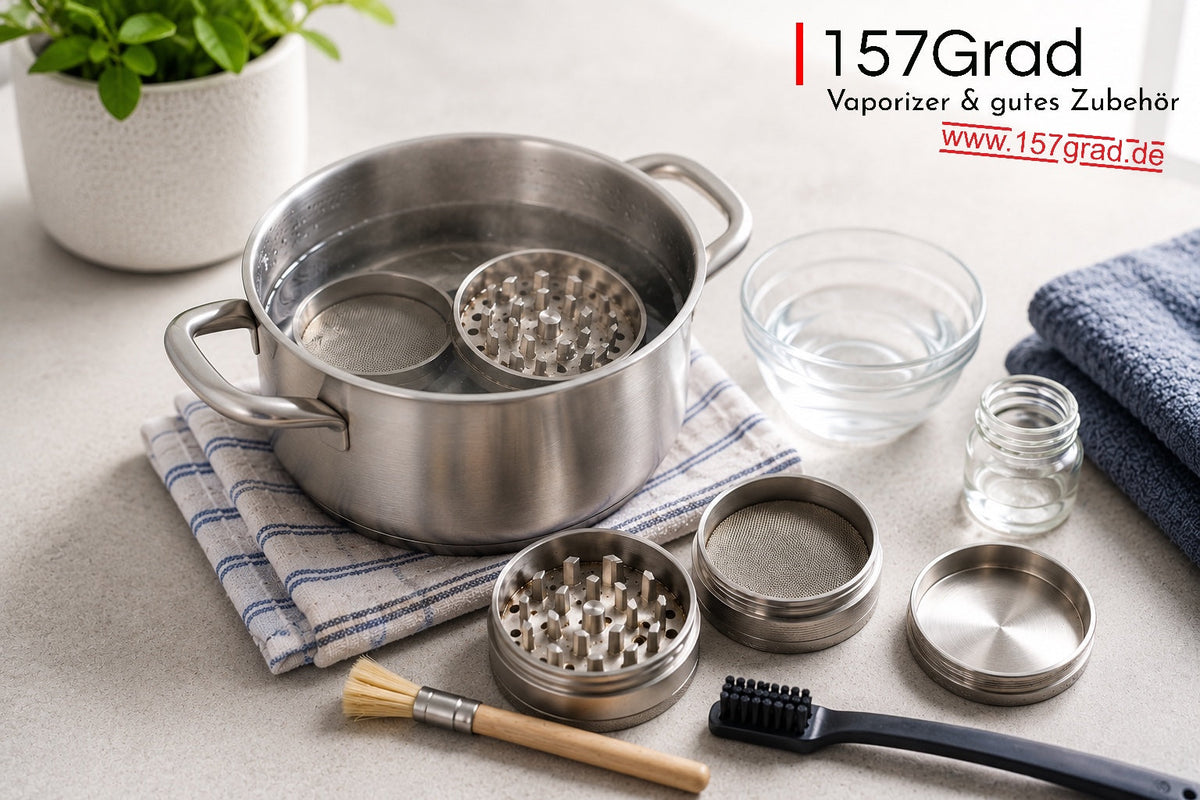
First, disassemble the device completely. Remove loose herbs and resin residues before using water or another cleaning agent. This prevents coarse residues from spreading in the pot and shortens the actual cleaning of your grinder.
How to proceed step by step
- Place the grinder briefly in the freezer so that sticky resin can be removed more easily.
- Disassemble all removable parts and check magnets, seals, and coatings.
- Carefully remove loose particles with a dry brush.
- Fill a suitable pot with enough water.
- Heat the water and only add clearly heat-resistant parts.
- Carefully remove the individual parts with tongs after a short time.
- Rinse everything thoroughly and let the parts dry completely.
When boiling a grinder with water, prolonged, vigorous boiling is usually not necessary. Often, very hot water is enough to loosen deposits more easily. After removal, you can remove any remaining residues with a soft brush. However, this method is not recommended for coated surfaces.
An important tip: Do not reassemble the device until all parts are dry. Moisture in tight threads can promote corrosion and an unpleasant odor. Boiling your grinder therefore only ends after careful drying and a final check, just like with the individual parts of a Dry Herb Vaporizer.
Boiling grinder with milk: Effect, duration, and temperature
When boiling a grinder with milk, the fat it contains is supposed to absorb resinous and fat-soluble residues. Since cannabinoids are fat-soluble, components from adhering resin can transfer into the liquid. Boiling in milk is therefore not only a matter of cleaning but also associated with health consequences that are difficult to estimate.
What to consider with milk
|
Point |
Classification |
|---|---|
|
Temperature |
Heat milk only at low to medium heat |
|
Duration |
Brief heating may be enough, there is no fixed time |
|
Effect |
Possible, but neither reliable nor controllable |
|
Taste |
Plant residues and resin can significantly alter it |
|
Smell |
Warm milk and residues can smell intensely |
|
Consumption |
Not recommended due to unclear dosage and possible material residues |
Those who want to boil a grinder in milk often wonder what effect drinking it might have. This cannot be predicted with certainty. The amount of residue is unknown, and temperature and duration also influence the result. Additionally, coatings, metal abrasion, or other contaminants can enter the milk.
There is also no universally applicable answer to the question of how long one should boil a grinder with milk. Long boiling does not automatically improve cleaning. Due to the poorly controllable effect, you should not drink the used milk afterwards. An intoxicating effect can set in delayed and last longer than with normal puffing.
Alternative cleaning methods for your grinder without long boiling
Alternative cleaning methods are often more sensible if you cannot clearly identify the material. A suitable metal grinder can often be cleaned with warm water and a brush. For uncoated metal parts, isopropyl alcohol can also be considered, provided you remove it completely and let the parts dry thoroughly afterward.
These alternatives have practical uses
-
Warm water is suitable for light soiling and is gentler than long boiling.
-
A brush reaches teeth, threads, and screens without heavily stressing the surface.
-
Alcohol or cleaning alcohol can dissolve stubborn resin on uncoated metal parts.
-
Boiling with oat milk offers few advantages and can leave additional residues.
-
Tea does not clean better than water and can cause odors or discoloration.
-
Cocoa contains additional components that can settle in threads and screens.
-
A quick dry cleaning after each use prevents heavy deposits.
Boiling a grinder with tea therefore brings no discernible cleaning advantage. Boiling a grinder with oat milk is also not a convincing alternative, as fat content and additives vary depending on the product. If you want to boil a grinder with cocoa, sugar and other components further complicate subsequent cleaning.
Regular cleaning of your grinder prevents resin from becoming deeply embedded in the threads. Tap out loose particles after use and clean hard-to-reach areas with a small brush. This way, you have to resort to elaborate methods less often, and your grinder remains smooth-running for longer.
Vapotools by 157Grad: Metal grinders in the shop with personal support
At Vapotools by 157Grad you will find various grinders for "broccoli" and other herbs. The models differ, among other things, in size, construction, and number of chambers. A compact metal grinder is well suited for on the go, while multi-part designs offer additional space for a sieve and a collection chamber.
In the shop, you can specifically choose a model that meets your requirements. Pay attention not only to the appearance but also to the material used and the construction. This information is particularly important if you later want to clean the grinder with water, alcohol, or another method.
Our personal support will help you with questions about care, material compatibility, or selection. This way, you can clarify before purchasing which cleaning method is suitable for the respective model. This protects the surface and supports long-term, reliable use.
Conclusion: How to keep your grinder clean and smooth-running for a long time
If you want to clean your grinder, first check the material, coating, and all sensitive components. Uncoated stainless steel may be suitable for boiling. Aluminum should be treated more carefully, while plastic, acrylic, and wood do not belong in boiling water.
Due to its fat content, milk can absorb resinous components. Nevertheless, boiling a grinder with milk is not a controllable method to achieve a certain effect. Due to possible contaminations and an unpredictable dosage, you should not drink the liquid.
Regular, material-appropriate care prevents heavy deposits. Often, a brush, warm water, and a little patience are enough. This way, your grinder remains clean, smooth-running, and reliably usable for a long time, which also ensures more fun with your vaporizer!