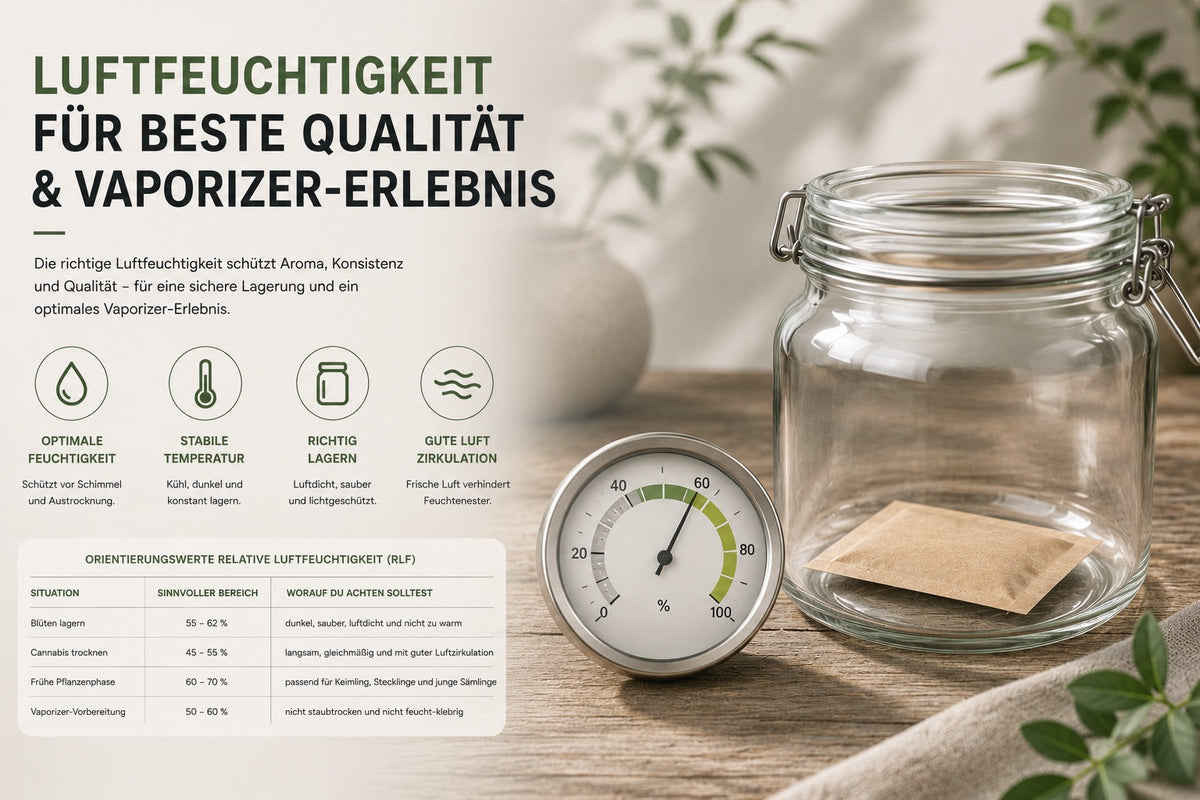
Good buds will only remain aromatic, clean, and pleasant to use if their environment is right. Therefore, cannabis humidity is not just about storage, but also about taste, consistency, and a good vaporizer experience.
Too much moisture can promote mold growth, while too little moisture makes buds brittle. Therefore, a practical look at temperature, air, drying, and safe storage is crucial for you.
Cannabis Humidity as a Foundation for Quality, Aroma, and Safe Storage
Humidity describes how much water vapor is present in the air. For cannabis, also known as broccoli, it influences whether a bud remains elastic, retains its aroma, and can later be ground cleanly.
High humidity can encourage mildew, musty odors, and soft spots. Low humidity, on the other hand, dries out buds, making them crumbly and potentially feeling harsher in the vaporizer sooner.
For vaporizer users, humidity is particularly important. Material that is too dry can cause an unpleasant scratch, while material that is too moist heats up slower and often vaporizes less evenly.
Relative Humidity as a Guide for Stable and Durable Cannabis Buds
Relative humidity indicates how saturated the air is with moisture at a given temperature. Warm air can hold more moisture than cold air, so readings change quickly when a room heats up or cools down.
Useful Values for Storage, Drying, and Use
|
Situation |
Recommended Range |
What to look out for |
|---|---|---|
|
Storing Cannabis |
approx. 55 to 62 percent |
dark, clean, airtight, and not too warm |
|
Drying Cannabis |
approx. 45 to 55 percent |
slowly, evenly, and with good air circulation |
|
Early Plant Stage |
approx. 60 to 70 percent |
suitable for seedlings, cuttings, and young plants |
|
Vaporizer Preparation |
medium range |
not bone dry and not sticky-damp |
A cannabis humidity chart helps you to better check values. However, it does not replace observing the smell, surface, and consistency of the buds.
70 percent can be useful for cuttings, during germination, or for very young plants. For finished buds in storage, this value is usually too high and should be taken seriously.
Ideal Temperature and Humidity for Storage Without Loss of Quality
The ideal temperature for stored buds is rather cool and stable. Heat, light, and strong fluctuations in air temperature can degrade terpenes and accelerate quality deterioration.
Practical Tips Against Typical Storage Mistakes
-
Store buds in a clean glass container, such as the Bormioli Rocco Glass 1500 ml with lid.
-
Avoid direct sunlight, as light and heat can negatively impact quality.
-
Check the optimal room humidity with a hygrometer instead of just guessing. For this, use, for example, the Vapotools by 157Grad - Digital Mini Hygrometer.
-
Do not store cannabis near heaters, as warm air can dry out the buds faster.
-
Ensure cool air, but avoid condensation.
-
Only use material for the vaporizer that smells clean and can be easily ground with a grinder.
-
Discard noticeable buds if you observe fuzz, spots, or a musty smell.
Optimal humidity not only protects against drying out. It also helps to preserve aroma, taste, and consistency so that your buds don't crumble into dust in the grinder.
Optimal temperature and appropriate humidity always go hand in hand. Good storage keeps both values as stable as possible and prevents the correct humidity from being disrupted by rapid temperature changes.
Plan Cannabis Cultivation by Phase to Match Climate and Growth
In cannabis cultivation, the climate heavily depends on the respective phase. A seedling needs different conditions than a robust plant in the vegetative stage or a cannabis flower just before harvest.
In the seedling phase, higher humidity often plays a more significant role because young plants react sensitively. Later, air circulation, water absorption, transpiration, and photosynthesis become more important for stable plant growth.
The vegetative phase, the growth phase, the flowering phase, and late flowering each require adjustments. Therefore, cannabis cultivation is not about a rigid value, but about climate, lighting, flower development, and regulation.
Control Indoor Humidity so Ventilation and Air Circulation Work
Indoors, the climate can be controlled better, but mistakes have quicker effects. Without ventilation, excess moisture accumulates, while an overly strong fan can unnecessarily dry out young leaves or substrate.
Warning Signs for Quick Adjustment
-
Condensation indicates that humidity might be too high.
-
Musty odor points to stagnant air or damp areas.
-
Drooping young leaves in seedlings can also react to overly dry air.
-
Very crumbly buds often indicate that the humidity was too low.
-
Sticky, soft-feeling buds should be checked more closely before storage.
-
Fresh air helps against local moisture pockets.
-
A hygrometer makes regulation more reliable than pure intuition.
If you want to lower humidity, better exhaust, less stagnant air, and a drier room help. If you need to increase cannabis humidity, it should happen in a controlled manner and not through improvised moisture sources.
For a cannabis grow, ideal humidity is also important because it can influence growth, yield, and later quality. Ultimately, it's not just about the plant itself, but a clean, usable result.
Prepare Harvest, Drying, and Curing for Better Taste
Around harvest, moisture becomes especially important. Cannabis drying should proceed slowly enough to preserve aroma, but dry enough to prevent mold formation.
The temperature and humidity during cannabis drying should remain as stable as possible. The question of what humidity to dry cannabis at can be broadly answered with a medium range that is neither damp nor bone dry.
After drying, curing and sometimes also the term fermenting follow. In practice, this usually refers to a controlled post-ripening, where residual moisture, taste, and shelf life come together better.
Store Cannabis and Prepare Optimally for the Vaporizer
If you want to store cannabis, think directly about later use. Buds with appropriate moisture can be ground more evenly, dosed better, and heated more smoothly in a portable or desktop vaporizer.
Too low humidity makes the material brittle. Then, at higher temperatures, it can quickly feel hot, dry, and harsh.
Overly moist buds are also unfavorable. They are harder to grind, vaporize more slowly, and can make cleaning your vaporizer, for example with rubbing alcohol, more laborious.
Use Boveda Packs to Keep Your Buds Stable Longer
Boveda packs are small humidity regulators for airtight containers. They can release or absorb moisture, thereby helping to maintain a more stable climate in the jar. For cannabis, variants with 58 percent and 62 percent relative humidity are particularly relevant.
Boveda Packs for Cannabis Compared
|
Boveda Pack |
What it's good for |
Especially useful when |
|---|---|---|
|
For slightly drier, easier-to-grind buds |
you are preparing cannabis for the vaporizer or prefer a slightly looser consistency |
|
|
For slightly softer, more elastic buds |
your buds dry out quickly or you want to preserve aroma and suppleness longer |
|
|
Small packs, e.g., 4 g or 8 g |
For small jars and manageable quantities |
you are storing only a few grams or using several small containers |
|
Larger packs, e.g., 67 g |
For larger jars and longer storage |
you regularly store larger quantities in an airtight container |
|
Very large packs, e.g., 320 g |
For storage containers and larger storage solutions |
you want to keep a large volume stable and the container seals sufficiently tight |
For vaporizer users, a Boveda pack with 58 percent is often pleasant because the buds are usually somewhat easier to grind. 62 percent may be a better fit if your buds dry out quickly or you prefer a softer consistency. The key is always a clean, airtight container, because without a tight jar, the pack cannot regulate humidity effectively. Alternatively, the Vapotools by 157Grad Stainless Steel Storage Container can also be used.
Conclusion: Correct Humidity Protects Cannabis and Improves Your Vaporizer Experience
Cannabis humidity is not a minor topic. It helps determine whether buds are safely stored, retain their aroma, and can later be pleasantly used in a Dry Herb Vaporizer.
For practical purposes, clear basic rules suffice: store cool, avoid strong fluctuations, measure humidity, and take abnormalities seriously. This way, you protect quality, taste, and consistency.
Especially as a vaporizer user, you benefit from stably stored buds. They are easier to prepare, heat more evenly, and ensure a more pleasant vaporization.